Sheffield United have been promoted to the Premier League, but are already being written off by many. Will the Blades be sharper than what most people think?
Sheffield United are back in the Premier League after pulling off an impressive promotion from the Championship. Managed by local lad Chris Wilder, and having fielded a squad with players only from the British Isles, the Blades are back in the big time after a 13 year absence. Perhaps due to their lack of big names and big spending, as well as how difficult the Premier League is for any newly promoted side, they are currently favourites to be relegated, with odds of 4/6. It is set to be a very tough season for Sheffield United, but could the Blades surpass the expectations of most, and be a surprise package this season?
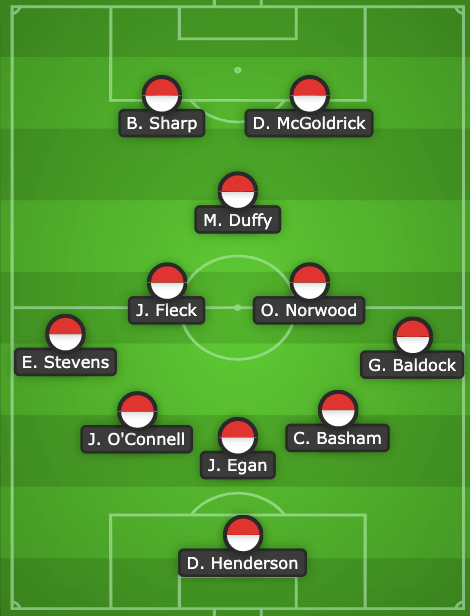
Last season, Sheffield United utilised the 3-4-1-2 formation, which transitioned into a 5-3-2 when they were without the ball. They were notoriously difficult to break down, partly due to the solidity of their system and hence boasted the joint best defensive record in the Championship. While being watertight at the back, they also scored plenty of goals and were at times, one of the more exciting – and certainly unique – teams to watch. The Blades’ strikers, Billy Sharp and David McGoldrick shared 38 goals between them, while the most used central midfield pairing of John Fleck and Ollie Norwood bagged 19 assists between them.
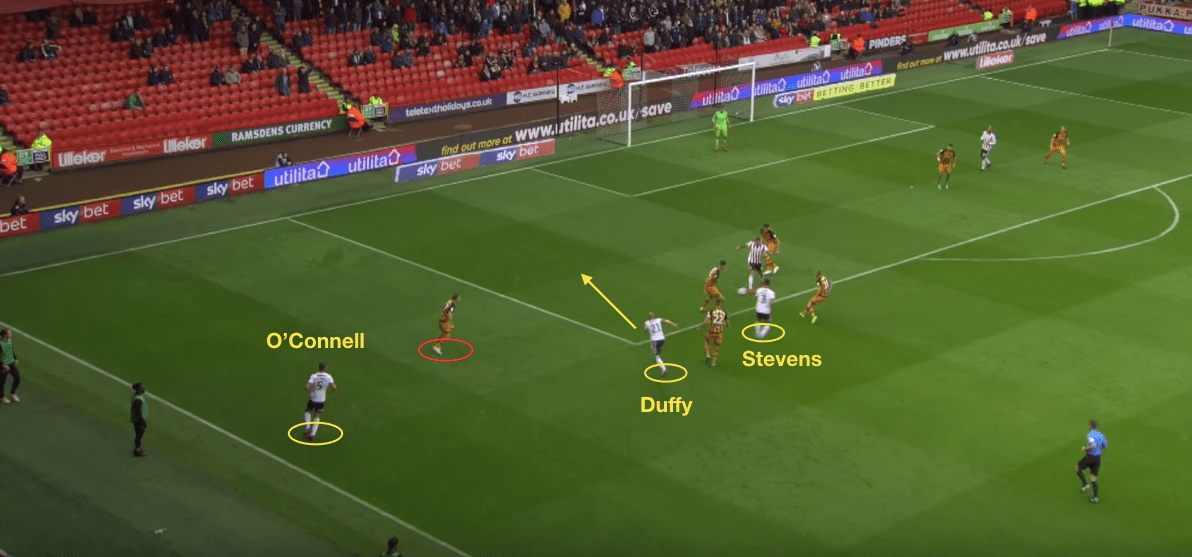
What gives them a large part of their uniqueness is the way in which their five man defence operates, and how they utilise their ‘overlapping centre backs’. When Sheffield United were resting with the ball, the wide centre halves, Chris Basham and Jack O’Connell often pulled out wide into fullback-like positions, while the wingbacks pushed forward into traditional winger positions. What then makes the ‘overlapping’ part is when Sheffield United are on the front foot, one of the the wingbacks (depending which side of the pitch the ball is on) will tend to drift into slightly more central areas to support the midfield, and often playing not too far off the strikers. This gives the wide centre-half the space to overlap, such to the extent that Basham and O’Connell often found themselves crossing it in or cutting it back from the byline. Meanwhile, the wingback from the opposite side was frequently encouraged to get forward and take up a position at the back of the area, to provide numbers in the box. Having the centre-backs run from such deep positions make them difficult to track for opposing midfielders, and therefore made it such an effective tactical ploy. While the wide centre backs and the wingbacks ventured forward, usually one of either Fleck or Norwood would drop in deep to cover while the central centre back, John Egan stayed back at all times.
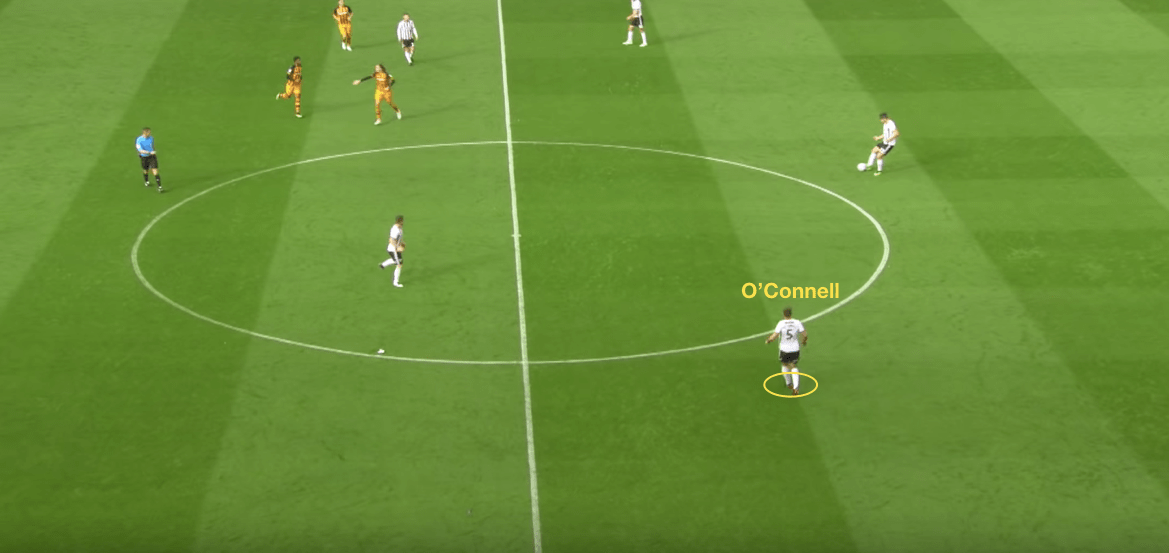
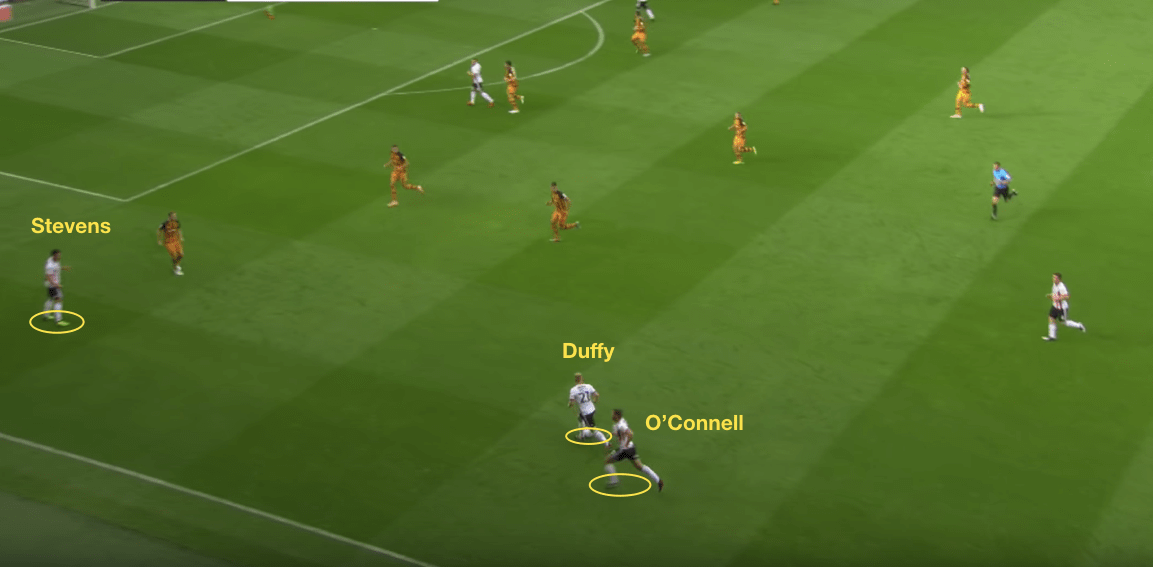
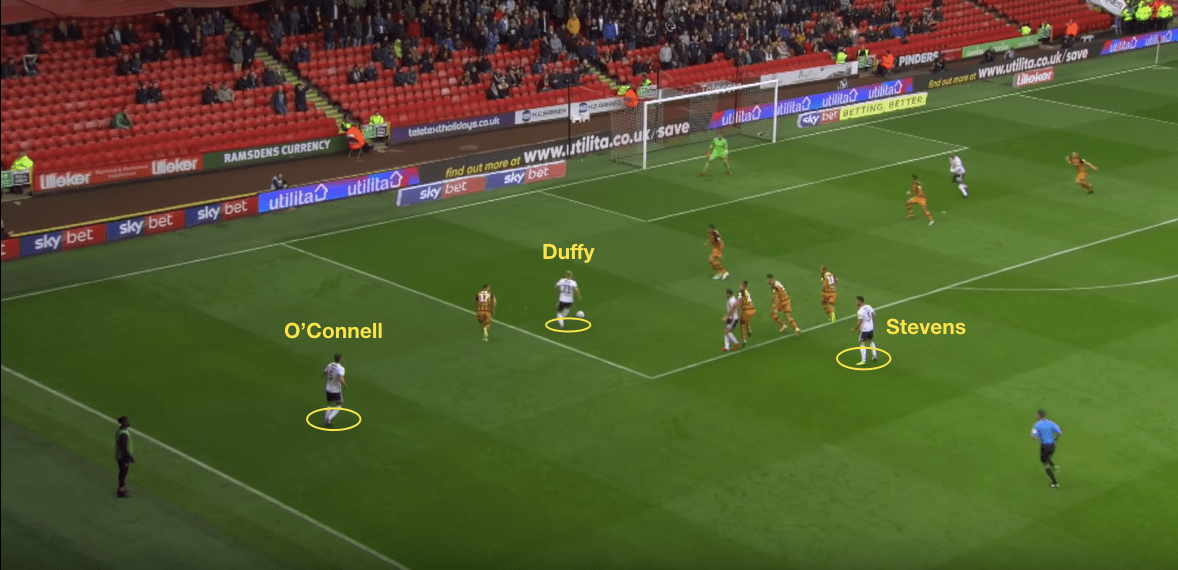
When defending, the backline often became a flat back five, with Fleck and Norwood shielding just in front. This quick transition from their attacking shape to their defensive shape was facilitated by the athleticism of their defenders, especially the dynamic wingbacks, George Baldock and Enda Stevens. However, perhaps when Sheffield United can be exposed is if they do lose it high up the pitch then their lack of cover can lead to the concession of high quality chances. Last season this wasn’t a problem due to the fact that Fleck and Norwood kept the ball well in midfield, but in the Premier League, with more teams playing high press football, this will be more difficult to do.
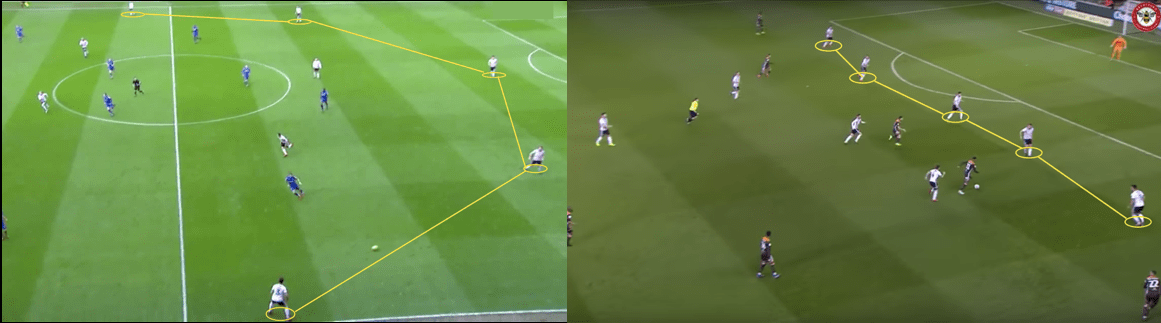
It is a concept that requires excellent flexibility, coordination and most of all, understanding. The Blades’ back five had plenty of all three, and hence they were so successful while using this strategy. It is a tactic that has never been seen before in the Premier League and there’s no doubt that the other 19 sides will be getting clued up on Sheffield United’s system before the season starts. In addition, it is one of the parts of Sheffield United’s play which will make them so interesting to watch, and tough to play against.
At the other end of the pitch, Sheffield United had no problems either, scoring 78 goals last season with Billy Sharp and David McGoldrick scoring 23 and 15 each, respectively. 33 year old Sharp seems to only be getting better with age, and there’s no doubt that his clinical finishing will be required next season as he takes on his second Premier League stint. McGoldrick was the perfect foil to Sharp, and is an experienced Championship striker who’ll be looking to make his make on the Premier League for the first time in his career. Attacking midfielder Mark Duffy is a creative spark for the Blades, capable of scoring and assisting in equal measure, as well as being a good ball carrier. Moreover, central midfielders John Fleck and Oliver Norwood are both seasoned professionals, with Fleck playing the workhorse role, while Norwood plays more like a deep playmaker.
The glaring issue in the Sheffield United squad seems to be the fact that the Blades’ have quite an ageing squad. The front three of Sharp, McGoldrick and Duffy are all above the age of 30, and the youngest player in their most used XI (barring on-loan Dean Henderson), was George Baldock at 25. Furthermore, despite having an experienced squad, there is very little Premier League experience within the squad, with only 30 Premier League appearances shared over three players, in their most used XI. This is without a doubt an issue that needs to be addressed, and the welcome addition of local boy Phil Jagielka will help solve the issue. Jagielka has 360 Premier League appearances under his belt, and is likely to slot straight into that back five, but it must be said that he is well past is best. Ravel Morrison has made his return to the Premier League and will be looking to clean up his reputation, but there is no guarantee that he’ll deliver. Callum Robinson, Luke Freeman and Ben Osborn arrive as midfielders with little Premier League experience, but were impressive in the Championship and will be aiming to prove themselves in the big time. However, just like Morrison, it is a risk and given their lack of experience, it might not be exactly what Sheffield United need at this point in time. 23-year-old Frenchman Lys Mousset has signed from Bournemouth for £10 million, and will be seen as a long term option to bolster their striking options. The problem with Mousset is that he’s far from a prolific goalscorer, having only scored 3 goals in 58 games for the Cherries, meaning that he’s not a surefire solution when it comes to scoring goals in the Premier League.

Lys Mousset 
Ravel Morrison 
Callum Robinson 
Luke Freeman 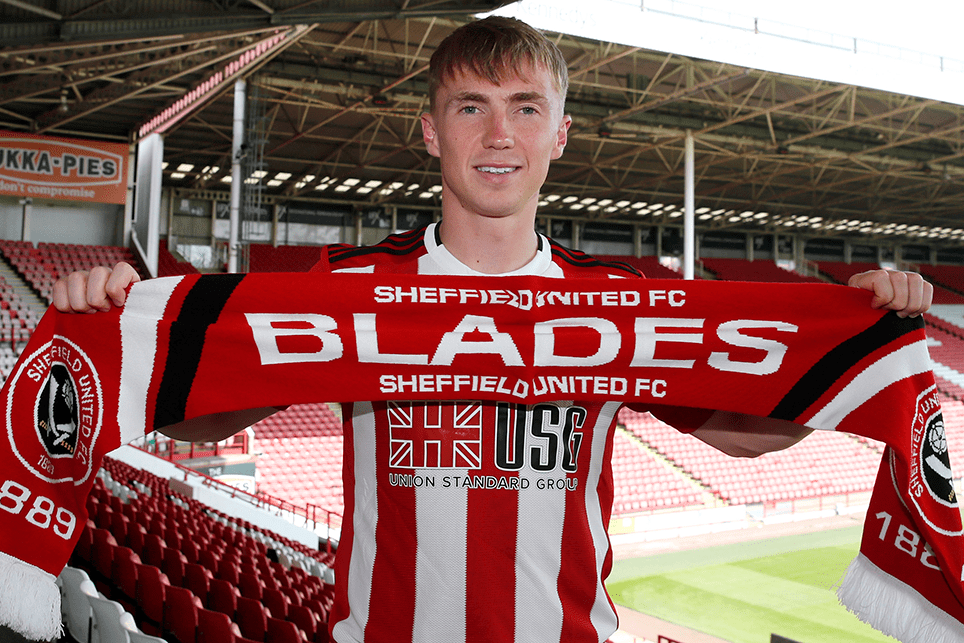
Ben Osborn 
Phil Jagielka
Many have already consigned Sheffield United to relegation before a ball has been kicked, largely due to having an ageing squad with few recognisable names. It is true that this will be an incredibly difficult season for the Blades, and it isn’t unreasonable to predict them to go down. They don’t have the financial strength to compete with many of the Premier League sides, which isn’t ideal considering that they have a squad in need of investment. However, what’s for sure is that they will bring togetherness, passion and Yorkshire fight to the Premier League, on top of being a well-drilled side. The vast majority of the players who played with them last season are in their prime and will be looking to prove themselves while they’re at their best. Their ‘overlapping centre backs’ will bring something different to the Premier League and could turn out to be a very effective strategy, and Chris Wilder is a shrewd and experienced tactician who shouldn’t be underestimated in the slightest. Sheffield United will be underdogs throughout this season and won’t be fancied by many – but the Blades might surprise a fair few of us this season.

 betweenthelines.sport.blog