Four, Four, Two. For so many years this was seen as the default formation used in English football, and was by far the most popular formation used in the First Division and the Premier League throughout the 20th century. However, as time has progressed, and tactical thinking has advanced, it’s fair to say that 4-4-2 has fallen out of favour in the footballing world. Claudio Ranieri gave the formation a lifeline while spectacularly winning the Premier League with Leicester City in 2016, but three years later, 4-4-2 still remains nearly extinct in Europe’s top divisions. The question is why has it become so unpopular, and does it still have a place and a use in 21st century football?
Advantages
4-4-2 is as simple as it gets when it comes to tactical understanding and hence it’s easy for players to understand and easy for coaches to explain.

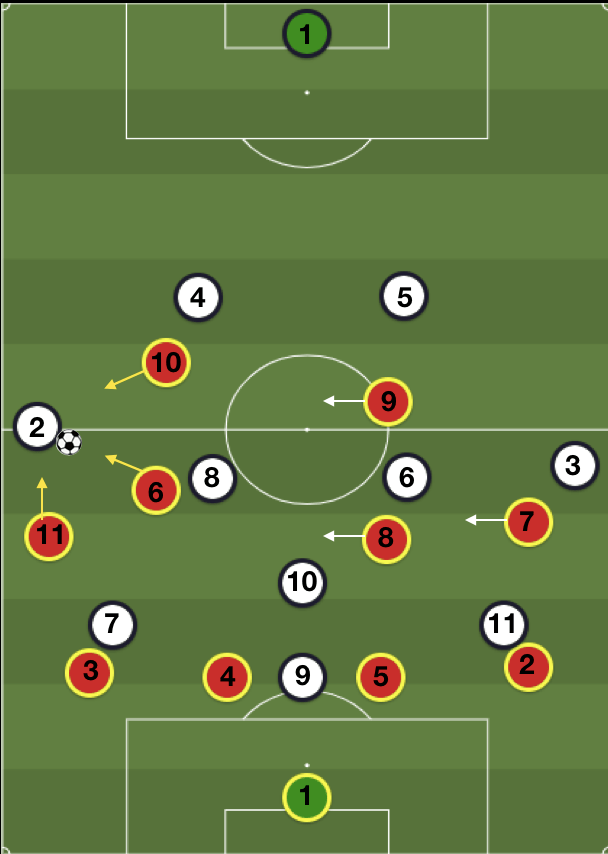
Having two strikers means that sides playing 4-4-2 can move the ball from back to front quickly and effectively, meaning that they dangerous in transition, and particularly on the counter. Although the profiles of strikers in a 4-4-2 can vary, it is likely that at least one of the strikers is particularly fast in order to get in behind and cause problems on the counter. A ‘little and large’ combination is often used, with the other striker being someone who can hold the ball up and bring the midfielders into play, but this isn’t always used.
The use of width in the 4-4-2 formation is one of its strong points as it helps to stretch the opposing defence, and helps to create overloads in the wide areas if the fullbacks get involved in attack too. The wide midfielders in 4-4-2 are of particular importance as they will be tasked with being able to offer plenty going forwards and will likely need to be good crossers of the ball, while they also need to be committed defensively and willing to track back and cement the defensive structure of the team. In Leicester City’s side of 2015/16, Marc Albrighton and Riyad Mahrez both carried out this job effectively and both played pivotal roles in the success of the Foxes that season. Arguably, the wide midfielders are the most important players in this system, considering a very particular type of player is required in this position to ensure the formation operates smoothly, similar to the importance of wingbacks in a five-at-the-back formation.
Almost always, the central midfielders are different types of players. One is usually more of a forward-thinking midfielder who will get forward and join in with attacks, while the other will play the role of a holding midfielder in order to protect the side from being vulnerable on the counter attack. A good example of this is how Sven-Goran Eriksson rarely used Steven Gerrard and Frank Lampard together in midfield when playing against a decent opponent, because both were too similar to each other, and neither were proper holding midfielders. As an alternative, he often used Lampard alongside Owen Hargreaves, Michael Carrick or even Ledley King, while pushing Gerrard out onto the left hand side or even dropping him altogether. Another effective combination used recently was Danny Drinkwater and N’Golo Kante in Leicester’s title winning season. Kante’s workrate and stamina combined with Drinkwater’s passing range made for a solid partnership that had much success.
Disadvantages
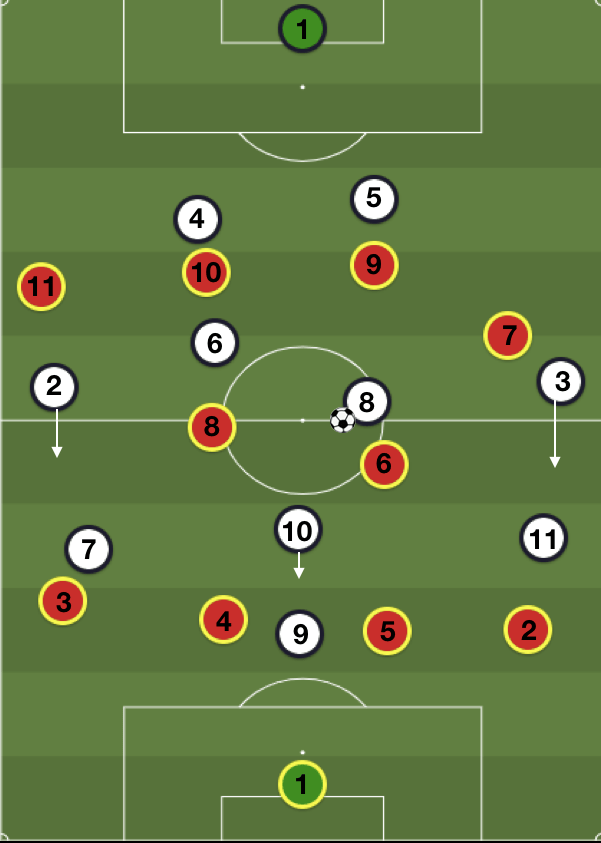
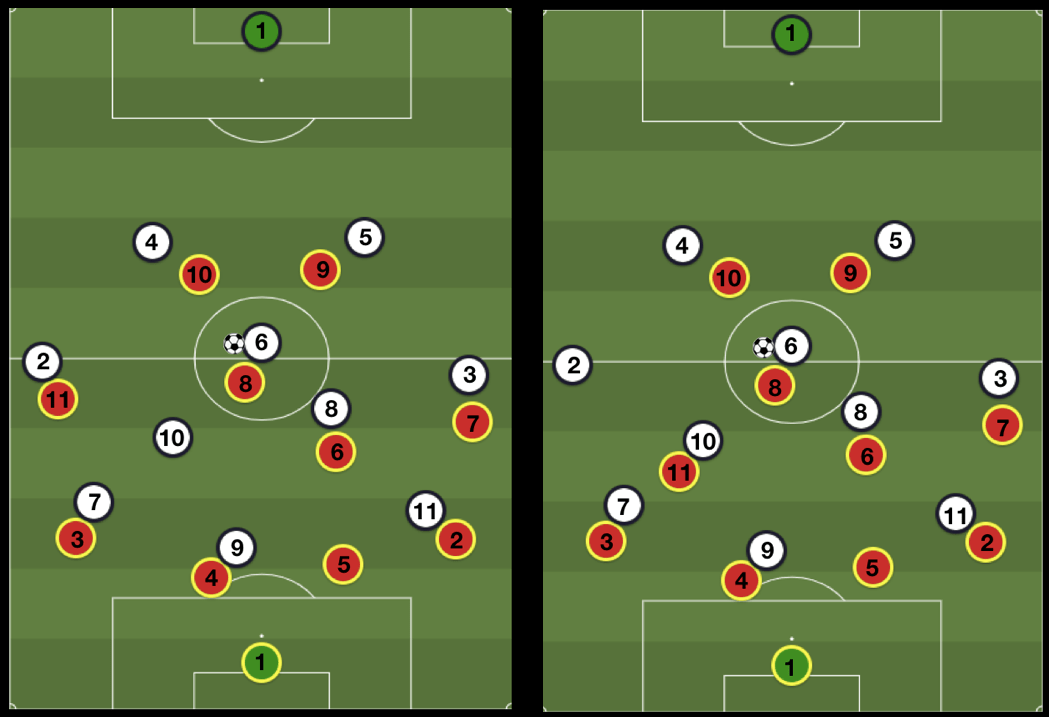
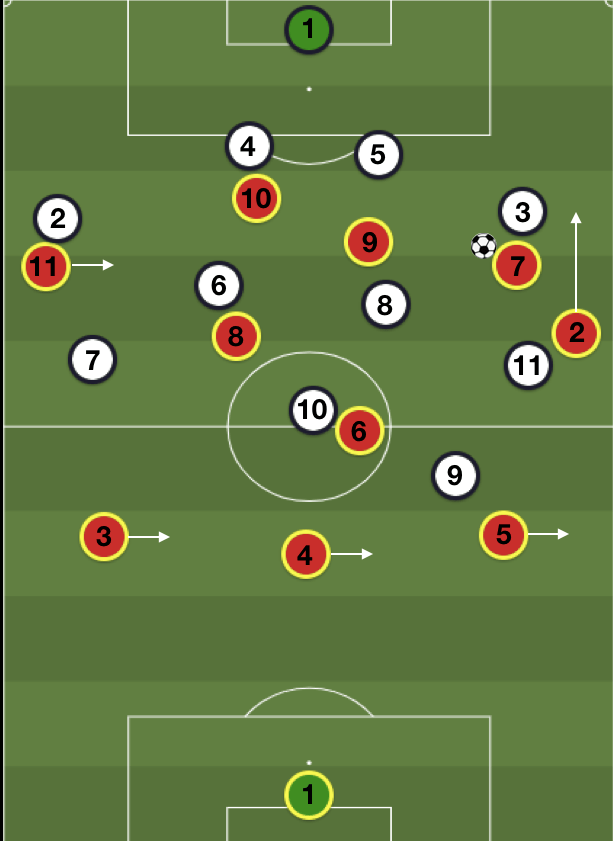
Having only two centre midfielders can mean that teams playing with the 4-4-2 formation are overrun in midfield, especially against teams with three men in midfield. Having a spare man in midfield means that the opposition will always be able to control the game. As a result, teams playing with the 4-4-2 formation often have little possession and are much more effective on the counter attack.
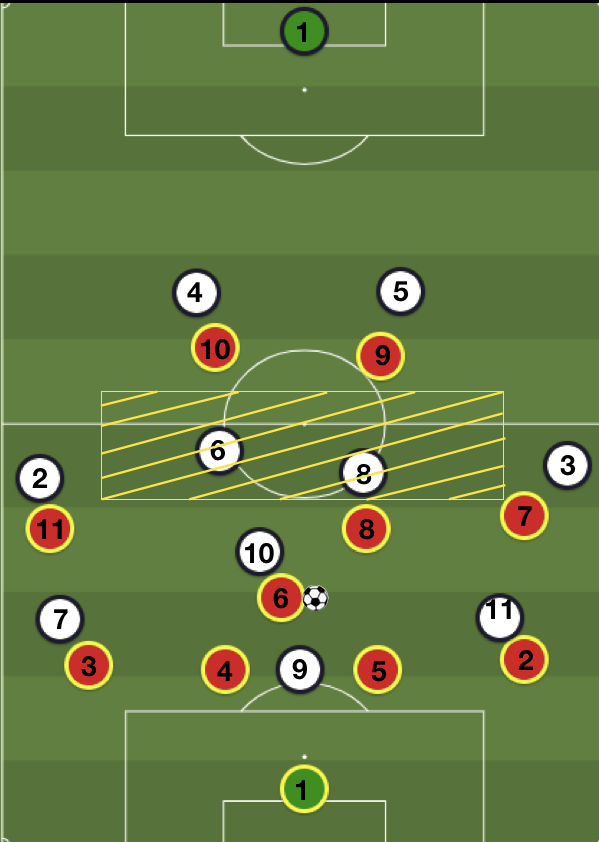
’Look, if I have a triangle in midfield – Claude Makelele behind and two others just in front – I will always have an advantage against a pure 4-4-2 where the central midfielders are side by side. That’s because I will always have an extra man. It starts with Makelele, who is between the lines. If nobody comes to him he can see the whole pitch and has time. If he gets closed down it means one of the two other central midfielders is open. If they are closed down and the other team’s wingers come inside to help, it means there is space now for us on the flank, either for our own wingers or for our full-backs. There is nothing a pure 4-4-2 can do to stop things’.
– Jose Mourinho
Conclusion
Overall, it is completely understandable that the popularity of 4-4-2 has fallen throughout the years. It is simple to understand as a formation, but it requires very particular types of players for it to work to any degree. Above all though, it simply isn’t complex enough, its age has meant that it’s been worked out by most teams, and in the 21st century it is relatively easy to combat. The increasing desire to play an attacking brand of football amongst Europe’s top teams has suppressed its popularity further due to it being a relatively defensive formation. Leicester City’s success in 2016 gave it hope, but the Foxes’ demise the following season under Ranieri indicated that they had been sussed out by opposition teams by then.
4-4-2 does have its strengths and is a good framework for a defensive system due to its compactness and simplicity, but for it to work offensively as well, it probably requires more flexibility and fluidity. Teams and coaches will probably continue to use 4-4-2 as a way of coaching defences, and helping players understand the importance and effectiveness of defending as a chain, but as we’ve seen over the last 10 years, 4-5-1 and 4-2-3-1 are becoming more popular formations to use in matches due to their greater offensive tactical flexibility. They give teams more lines and more passing angles, and therefore these formations are more difficult to predict and exploit for opposing teams. Furthermore, having a number 10 or an extra centre-mid rather than another striker can allow teams to not get dominated in midfield as easily. 4-4-2 will not become extinct and certainly has taught us plenty about the principles of shape in football, but I’d say that its appearances in matches will become few and far between over the next few years.

 betweenthelines.sport.blog