In the midst of Premier League sides scrambling to reinforce their squads in the quick six-week turnover between the 19/20 and 20/21 seasons, Chelsea have unarguably had the strongest window in the league so far. The shrewd acquisition of playmaker Hakim Ziyech in February, followed by the signing of German talisman Timo Werner have seen Chelsea significantly bolster their front line in preparation for their new campaign. In addition, left back Ben Chilwell signed a five-year deal with the Blues after a £45 million transfer, and talks over Kai Havertz continue to rumble on.
However, despite a strong season in which they secured a Champions League berth in 4th place, Chelsea had the 11th best defence in the league last season and as a result, the Blues’ defence will be seen by Frank Lampard as an area in which they can improve.
The signing of Ben Chilwell will provide them with a left-back who is more defensively capable than Marcos Alonso and Emerson, while also possessing the ability to influence the game in the final third too. A replacement for the underperforming £72 million goalkeeper Kepa Arrizabalaga is sorely needed at Stamford Bridge as well but looks unlikely to arrive in this window.
A centre-back is therefore next on the agenda for Frank Lampard in the hope that they can tighten up at the back with a new recruit who can provide defensive solidity while also possessing the ball-playing ability that is required in Lampard’s Chelsea system. Many names have been linked over the last 12 months, with Dayot Upamecano and Kalidou Koulibaly being the popular ones amongst Blues faithful. Those two will probably be outside Chelsea’s budget for this season, with links to more realistic options such as Lewis Dunk, Thiago Silva, Malang Sarr and Jose Maria Gimenez coming to light in the last month or so.
So, while Lampard and his scouting team scour European football to find the right man, I thought I’d use statistics and data from last season to determine the players who Chelsea maybe should be looking at as options to strengthen the spine of their team.
The Current Situation
Chelsea have four main candidates to play in central defence for them at the moment: Kurt Zouma, Andreas Christensen, Antonio Rüdiger, and Fikayo Tomori. Assuming they continue to play with a four-at-the-back formation, which they did in 30 league games last season, then Lampard’s task will be to find a functioning partnership of centre-backs who compliment each other, which is something he struggled to do last season.
The following are the partnerships used by Lampard throughout the season (whenever Chelsea played 4ATB), and the amount of goals each partnership conceded on average. The performance of each partnership is important, and I’ll touch on why different combinations did better than others soon.
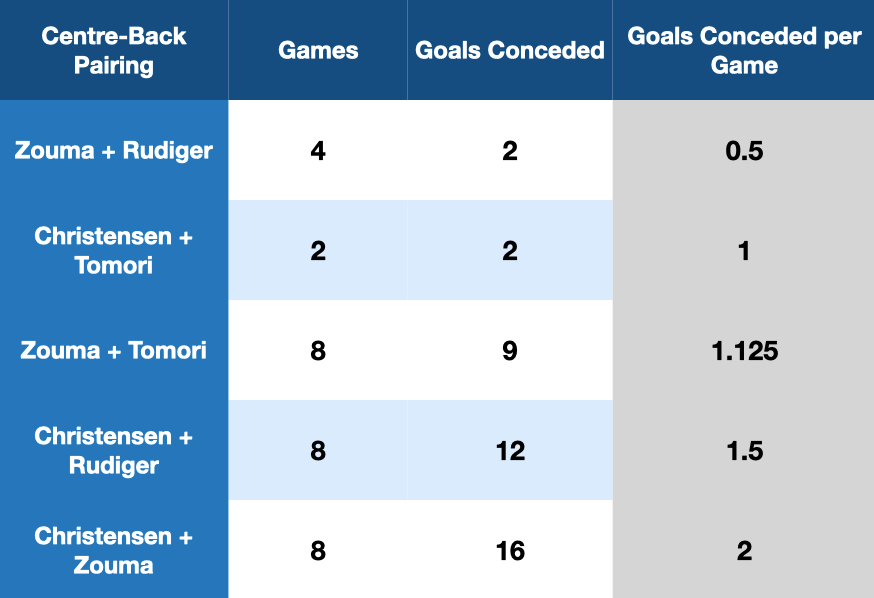
As you can see, the partnership that conceded the most goals on average, and was therefore the weakest, was the Zouma and Christensen pairing used by Lampard in the early part of the season while Antonio Rüdiger was injured. But while this might not seem significant, I think there was a serious flaw in that partnership which unsurprisingly reflects in their success as a pairing.
What I believe it comes down to is having a partnership that has a ‘front-footed’ centre back, and a ‘back-footed’ centre-back. This is an idea which isn’t talked about a lot in football, but is so clearly relevant to the way teams set up nowadays, and many of the top teams who play high defensive lines (like Chelsea) have centre-back pairings that contain one of each.
When the opposition team is attacking centrally, the role of a ‘front-footed’ centre-back is to be the more aggressive defender who is more likely to step up and make tackles and interceptions, looking to win the ball back as quickly as possible. When opposition play bypasses the midfield, then it is the role of the more front-footed defender to close the gap between defence and midfield, in an attempt to actively halt the opposition’s attack, either intercepting forward passes or winning the ball back in one-on-one situations.
Meanwhile, the more ‘back-footed’ defender is more responsible for covering in behind and sweeping up anything that is played behind the defensive line. They tend to back off a little more when the opposing team breaks forward, and they look to win the ball back using their pace and positioning.
The best examples of this type of pairing include Liverpool’s Joe Gomez and Virgil van Dijk, and PSG’s Presnel Kimpembe and Thiago Silva (two players we’ll hear more about later on). Liverpool’s centre-back duo requires Gomez to be more active in closing opposing players down, while van Dijk successfully covers the space behind using his pace and excellent positioning (meaning he conveniently doesn’t get dribbled past very often).
How This Impacts Chelsea
Simply, when Chelsea use a combination of a front-footed defender and and a back-footed defender, that’s when they’re most successful. Andreas Christensen and Kurt Zouma are both front-footed defenders who look to win the ball back early in an opposition’s attacking phase, through their ability to tackle and intercept well, before looking to start a Chelsea attack in transition.
On the other hand, Antonio Rudiger and Fikayo Tomori and back-footed and reactive defenders who are both quick and can read the game well enough to cover behind the defensive line. They also prefer to stay patient in one-on-one situations and try to stay with an attacker rather than impulsively flying into a tackle, meaning they make a fairly high amount of blocks and a slightly lower amount of tackles and interceptions compared to Christensen and Zouma.
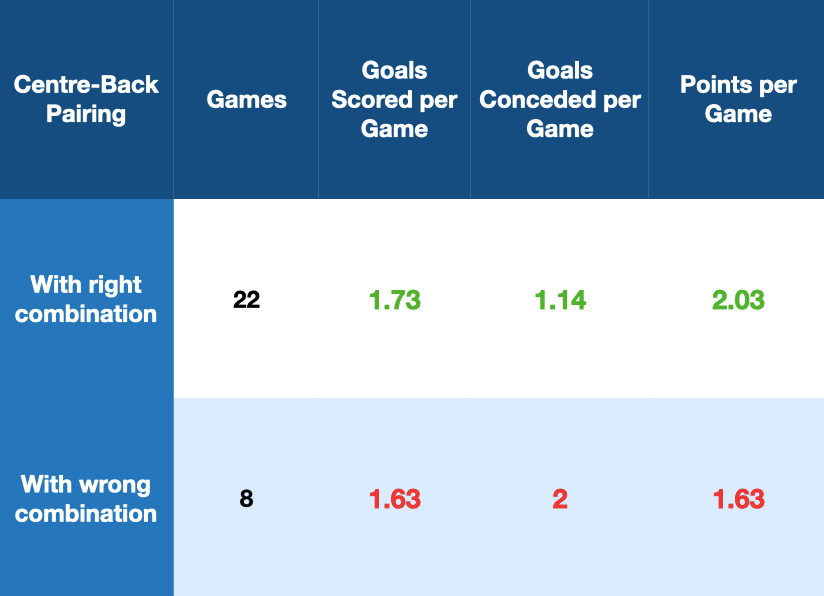
As we can see, the least successful pairing was Zouma and Christensen, who are both more front-footed defenders who prefer to engage rather than back off. In fact, when we look at Chelsea’s performances when they played with the correct combination and when they didn’t, there’s a stark contrast in the goals scored, goals conceded, and points per game. This further highlights the importance of having two centre-backs who compliment each other rather than two centre-backs who have similar playing styles.
What Does This Mean For Chelsea’s Recruitment?
If Chelsea are in the market for one centre-back signing, then they need to decide which one of their current centre-halves they’re most comfortable with, and look to find a suitable partner for him. It looks likely that Lampard will back Kurt Zouma as his best current centre-half, and will look for a back-footed centre-back to partner him. However, judging by some of their targets, it is also possible that Lampard might rely on the experience of Rudiger and promise of Tomori, while offloading Christensen, meaning the Blues’ would be signing a more front-footed centre-back.
As a result, I thought I’d use data from last season’s Top 5 European Leagues in order to explore some of the options that might fit Chelsea best statistically. It is notoriously difficult to gauge the ability of centre-backs through statistics, but I’ve tried to use a combination of metrics that caters for the role the player will play in, and Chelsea’s style of play in the hope that it will give me a fairly accurate result in terms of who will suit Chelsea the best.
The Search for a Front-Footed Centre Back
I created a database that included every defender (unfortunately FBref doesn’t differentiate between centre-backs and fullbacks, and it would take me forever to do it manually) in the Top 5 Leagues, spanning over 49 different metrics that I felt were important to centre-halves in Chelsea’s set up.
As mentioned earlier, the roles played by front-footed and back-footed centre-backs are different, and hence certain factors are more important than others in either position. As a result, the criterion created in order to whittle these players down to a select few were slightly different for either role.
The criteria for a front-footed centre-back was as follows:
Percentage of Dribblers Tackled, min 42%.
- a large part of the defensive work done by a front-footed centre-back tends to be tackling, and hence being solid in this area is clearly of importance.
- The average of Christensen and Zouma (front-footed centre-backs) is 41%, so we’re just looking to better that.
Successful Pressure Percentage, min 38%
- Pressing isn’t usually associated with centre-backs, but nowadays with how high many defensive lines are (including Chelsea’s), it’s the front-footed centre-back’s job to squeeze the space between midfield and defence, looking to win back possession quickly and high up the pitch. The requires sensible and effective pressing.
- Chelsea average is 37%, so once again we want to improve on that.
Pass Completion, min 88%
- self explanatory, a team that looks to keep possession like Chelsea needs centre-backs who can pass accurately.
- Same as Chelsea’s average.
Long Pass Completion, min 80%
- Ball-playing centre-backs are required to not only be comfortable on the ball but also be able to spread the play through long passes in order to stretch the opposition’s defence.
- Lower than Chelsea’s average of 85%, which is already pretty high in the grand scheme of things, so didn’t want to unfairly eliminate players.
Short Pass Completion, min 30%
- Yes, that sounds very low, but these are passes that are less than 5 yards. So, these tend to be short, difficult passes in tight spaces and hence completion is generally very low for most players. e.g van Dijk had a short pass completion of 27.3% in 18/19.
Progressive Passing Distance per Touch, min 3.5 yards
- Chelsea’s defenders are asked to play the ball out from the back, and hence being able to successfully progress the ball regularly is of massive importance not only at Chelsea, but in the modern game.
- I used per touch to accommodate for players who don’t get as much of the ball because they play for a side who generally have less possession. It also means players like Laporte don’t have massively inflated numbers due to the fact that he touches the ball a ridiculous amount of times per game (his numbers are still very impressive nonetheless).
Tackles + Interceptions to Blocks Ratio, min 2.4
- This is done to separate the front-footed and back-footed centre-backs.
- As mentioned earlier, back-footed defenders are more passive in one-on-one situations and are more likely to block shots late in an attacking phase, whereas front-footed centre-backs actively look to tackle and intercept more often.
- With a bit of knowledge of these players and experimenting with the numbers, I found 2.4 to be an accurate cut off point. e.g. van Dijk (back-footed) has a ratio of 2.03, while Joe Gomez (front-footed) has a ratio of 2.67. There are many more examples like this.
So that was the criteria that I was going to use to eliminate 695 players down to hopefully, just a few candidates. A simple Excel filter later, and here you go, this is what it spewed out.
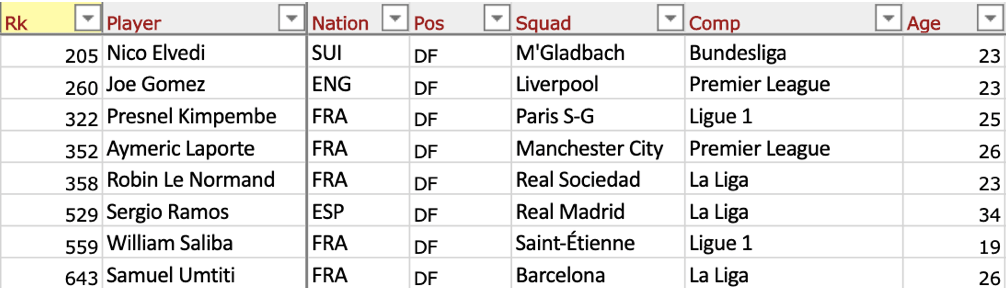
695 had become 8, and it was a fairly star-studded list. Remember, these are the players who are *statistically* best suited to playing as a front-footed centre-half for Chelsea, and there’s no metric which deciphers whether or not a player is attainable for Chelsea.
So, straight off the bat, we can eliminate Joe Gomez, Presnel Kimpembe and Aymeric Laporte. All three of them are top class centre-backs who would walk into Chelsea’s back line, but in reality, they are far from attainable targets for Lampard’s team, simply because none of their sides would be willing to sell them.
Sergio Ramos probably falls into the same category as well, after a stellar campaign with La Liga champions, Real Madrid. Despite being 34, Ramos still can prosper at the highest level and there’s no chance that Los Blancos will want to lose their captain, and the anchor of their defence.
William Saliba is obviously another impossible one given that he is embarking on his first full season at his new club Arsenal, but the fact that he ranks so highly in all of these metrics is a clear nod to the fact that Arsenal have a really good player on their hands.
After eliminating those five, we’re left with the final three who are realistic signings for Chelsea to use as a front-footed centre-back this season.
Nico Elvedi
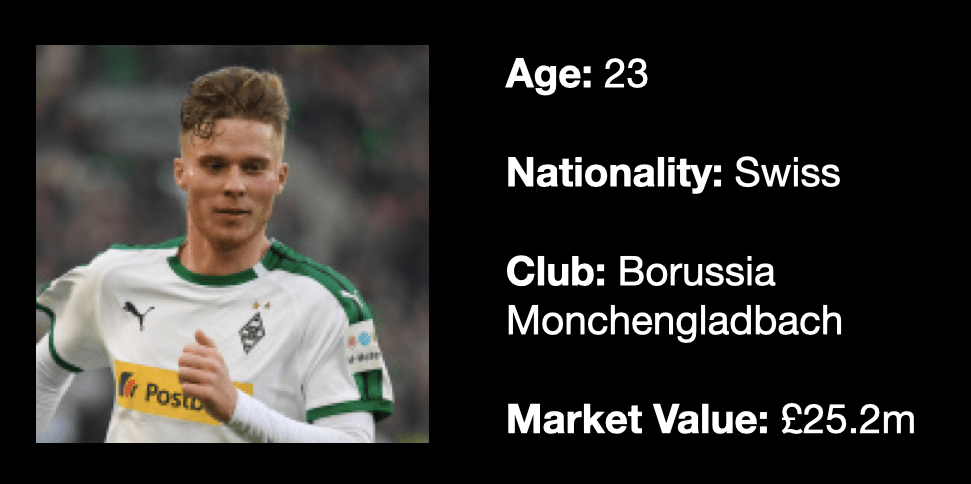
In terms of realistic and attainable signings for Chelsea, I’d say that Elvedi is the most suitable signing from the list. Elvedi has impressed in the Bundesliga after breaking into Gladbach’s side aged 18, and is currently one of the most consistent defensive performers in the league. He is very comfortable on the ball, and boasts an excellent switch of play, with 92.8% long pass completion. Elvedi also has a very impressive 2.51 yards progressive distance dribbled per touch, illustrating how effective he is at carrying the ball out from the back. In addition, he and Umtiti are the only two players on the list of eight who haven’t made an error leading to a shot all season, which is quite a remarkable feat.
Nico Elvedi would be a slightly risky signing given his age and lack of Premier League experience, but he’s one who I can certainly see being capable of coping with the demands of English football. He’d wouldn’t be a surefire solution to Chelsea’s defensive issues, but he’s a player that can improve over time and become a top quality player under the correct guidance. At roughly £30 million, Elvedi would be a very shrewd and long-termist bit of business for Chelsea.
Robin Le Normand
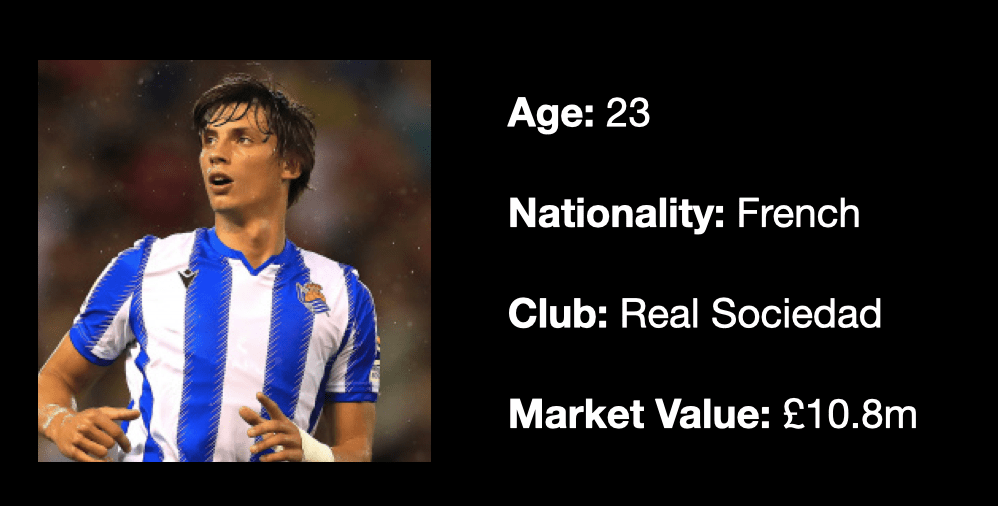
Robin Le Normand is far from a household name in the European footballing world, but his breakthrough at Real Sociedad this season has seen him become a reliable part of the young Sociedad side that finished 6th last season. He’s an excellent one-on-one defender, with an impressive 61.1% of dribblers tackled. He’s also very comfortable on the ball and is a more progressive passer than Elvedi, with 4.15 yards progressive passing distance per touch, compared to Elvedi’s 3.79.
The main issue with Le Normand is that he isn’t at Chelsea’s standard yet, and certainly won’t be looked at as an option to walk into Chelsea’s backline. However, at 23, he has time on his side, and he might be seen as one for the future. The fact that his stats are so impressive might suggest that mid-table Premier League sides should consider him as a promising option in central defence.
Samuel Umtiti
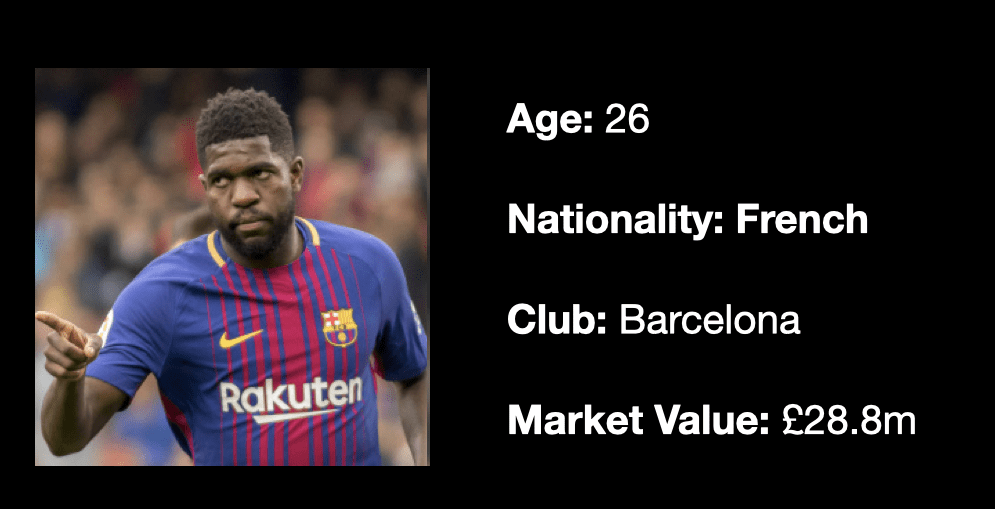
World Cup winner Samuel Umtiti is definitely the most high profile defender left on the list, and according to Spanish media, the Frenchman could be up for sale this summer alongside many other Barcelona stars. Umtiti has been pushed down the pecking order at Barca since the arrival of compatriot Clement Lenglet, and it is expected that he’ll depart Barcelona in the coming months.
Umtiti’s greatest strength lies with his ball-playing ability, and boasts some of the best passing stats amongst centre-backs in Europe. He has a remarkably high 4.94 yards progressive passing distance per touch, as well as 5.43 passes into the final third per 90. He’s also very confident at carrying the ball out of defence, and is fairly quick too, with both of these attributes partly being due to Umtiti playing as a left-back during his early days.
He’s a strong and committed defender, although his primary weakness is his impulsiveness and tendency to over commit to tackles, leaving his defence exposed. He was also known to be error-prone in the earlier part of his career, but this is something the Frenchman has improved with experience. All in all, Umtiti is a top-class defender who’d undoubtedly improve Chelsea’s defence, although he’d probably command a fee closer to the £50 million mark.
The Search for a Back-Footed Centre Back
I now had to do the same thing again, but this time with a slightly different criteria that would help me find more back-footed centre-backs that could fit Chelsea’s system and solidify their back line.
The criteria was similar in many ways, with a couple of slight tweaks to suit the differences in play styles between the different roles.
Percentage of Dribblers Tackled, min. 58%.
- This needs to be high for back-footed centre-backs since they’re far more conservative in one-on-ones, as they’re often the last man when in those situations. Hence, they can’t afford to get beaten as often. In addition, they’re less likely to fly into risky 50/50s like a more front-footed centre-back would do, and as a result they will have a higher tackle success.
- The average of Tomori and Rudiger was 57%, so once again the aim is to better them.
Recoveries per 90, min. 10.
- Recoveries measure how many times a player picks up a loose ball. A back-footed centre-back will be required to sweep up anything that breaks behind the defensive line, and recoveries partly look at how often a player is able to do that.
Pass Completion, min. 88%
Long Pass Completion, min. 80%
Short Pass Completion, min. 30%
Progressive Passing Distance per Touch, min. 3.5 yards
Tackles + Interceptions to Blocks Ratio, max. 2.4
- Just the reverse of the front-footed criteria.
Once again, when we input that into our database, we have a handful of players thrown back at us.
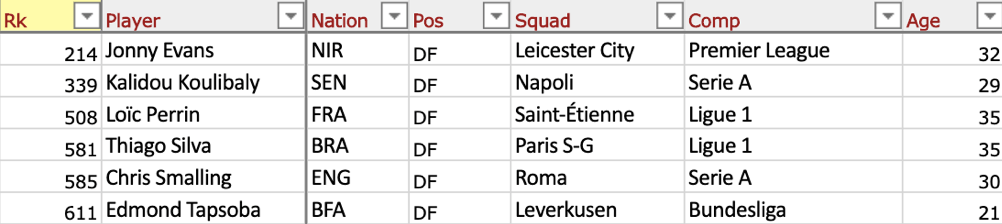
Six players are returned our way this time, and again we can scratch a couple off the list because they’re simply impossible given the current climate. Loic Perrin, who’s probably the most left-field one on this list, definitely won’t be on Chelsea’s wish-list given the fact that the 35 year old has chosen to hang up his boots.
Jonny Evans is also an extremely unlikely one given how important he is to Leicester City, and with only a couple of weeks until the Premier League kicks off, there’s simply no way Brendan Rodgers will let him go. He’s also one that we’ve seen plenty of in English football over the last decade, so there’s no real need to talk about him in much more detail. Similarly, Smalling looks likely to stay in Italy for next year’s campaign too.
That leaves us with three semi-realistic signings that Chelsea could make this summer if they’re after a more back-footed centre-back.
Kalidou Koulibaly
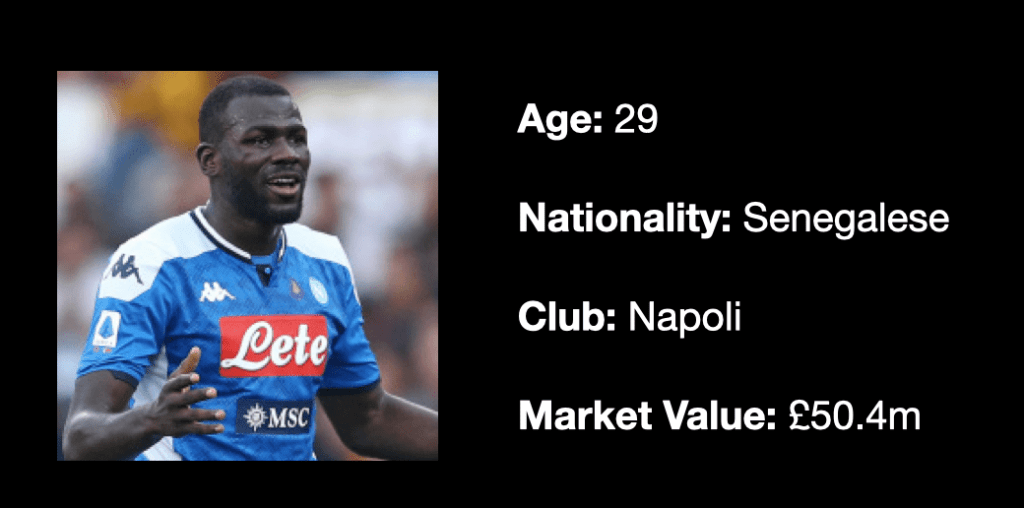
Kalidou Koulibaly is already rated as one of the best centre-backs on the planet, and has been a long term target for Chelsea. At 29, he’s at his peak, and there’s no doubt that he’s being courted by many of Europe’s elite.
Koulibaly’s primary strengths lie in his excellent positioning and his ability to read the game very well. He also uses his pace to keep up with quicker strikers, meaning he rarely gets beaten in a foot race when passes are played in behind, making him the ideal type of defender to cover behind the defensive line. He’s also excellent in one-on-one situations, where Koulibaly often uses his strength to knock opposing attackers off the ball, before winning it back.
His ball-playing ability is also exemplary, with 6.15 yards progressive passing distance per touch (Chelsea average is 4.67), 6.2 passes into the final third per 90, and short pass completion of 78.3%. These are some the best passing statistics of all defenders in European football. His only real weakness is his aerial ability, where Koulibaly only wins 56.9% of aerial duels, which is lower than any other centre-back that appears in this search.
Ultimately, Kalidou Koulibaly is the ideal signing for Chelsea when it comes to ability and being a good fit. He’s a fantastic defender and is one of the best ball-playing centre-backs in the world, and would instantly improve the Blues’ defence. Chelsea seem to have cooled their interest in him, maybe due to Napoli’s asking price, however Manchester City remain keen on the Senegalese defender.
Thiago Silva
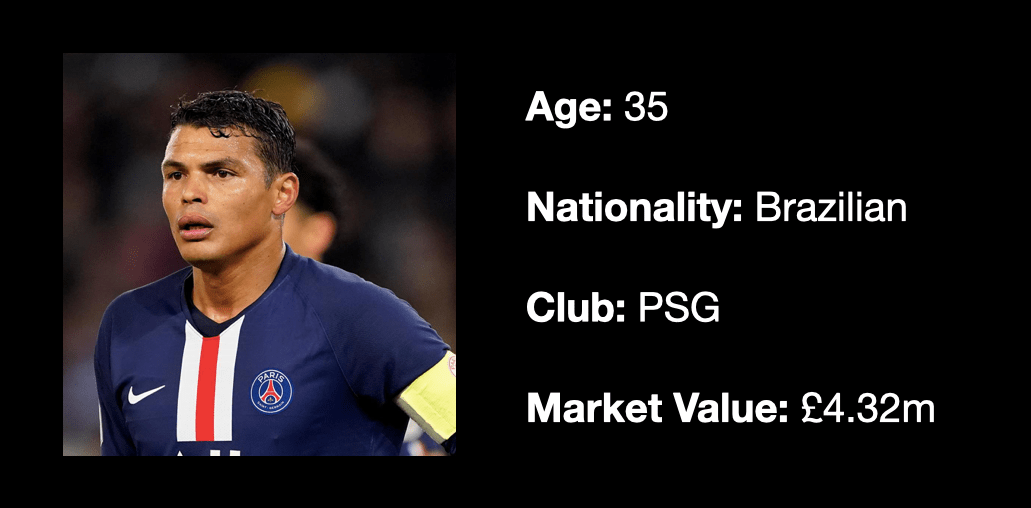
When it comes to experience, there are very few who can offer more in that department than Thiago Silva. An excellent defender who has made 297 top flight appearances, received 89 international caps, and has captained his country on numerous occasions, Silva would arguably be the best option if Chelsea require a player who can provide ability and experience, at an affordable price (free after his contract expiry at PSG).
Thiago Silva, like the others on this list, is known for his pace and superb positioning which make him very adept at playing as a back-footed centre-back. While he’s lost some of his pace as he’s aged, the Brazilian still has the nous and excellent spatial awareness to martial PSG’s defence and cover behind the defensive line while Kimpembe usually steps up and actively looks to win the ball back.
In addition, he’d bring plenty of leadership, something Chelsea lack in central defence. Tomori, Zouma and Christensen are all 25 years old and under, so an experienced leader who can organise their defence would be a welcome addition.
All in all, Thiago Silva would be a very smart signing from Chelsea’s point of view, given the fact he’s available on a free transfer, which will allow Lampard to splash the cash elsewhere. He’s still a top quality centre-back who’s capable of competing at the highest level, and he’s the ideal short-term option for Chelsea, who can solidify their defence while they look to transition back into being one of Europe’s top sides.
Edmond Tapsoba
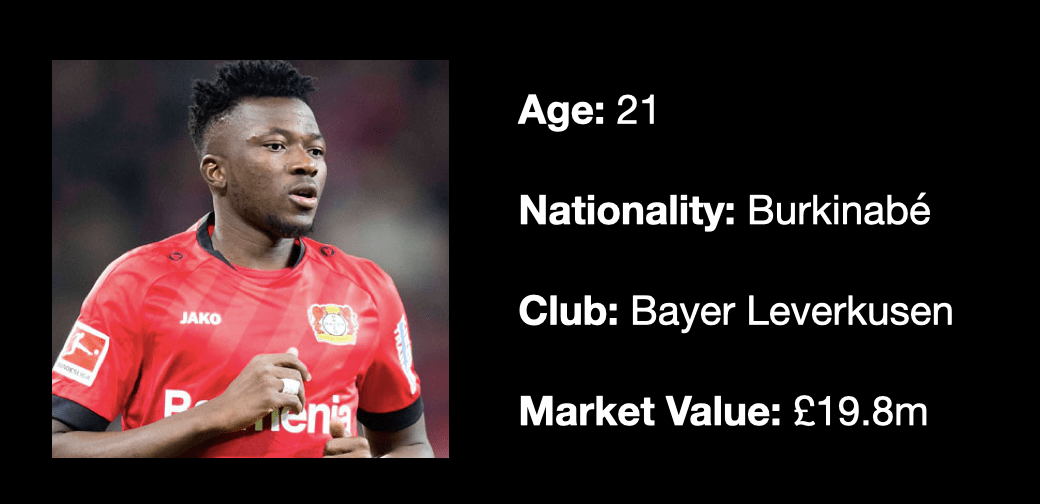
After a £16m move from Vitoria Guimaraes to Bayer Leverkusen, Edmond Tapsoba has seamlessly adapted to life in the Bundesliga. After an excellent 19/20 campaign, the Burkinabé centre-half has already cemented himself as one the best defensive prospects in European football.
He’s another quick centre-back who uses his pace to sweep up behind the defensive line, and his natural defensive instincts mean that his starting position is usually very good too. Having played in high defensive lines at both Vitoria and Leverkusen, he’d be instantly comfortable with Chelsea’s system, and certainly has the attributes to be a success at Stamford Bridge.
He’d be a pricey option given the fact that Leverkusen will want to protect one of their most valuable assets, but he’d be an excellent long-term signing for the Blues, or any other top English side.
Conclusion
So, there it is. We’ve trawled tonnes of data from the top 5 European Leagues in the search for centre-backs who’d stylistically fit Chelsea, and in the end, we’ve found 6 names, all of varying quality, who could fit the bill for the Blues.
Coincidentally, as I’m writing this, it looks like Thiago Silva might well be on his way to Chelsea, which makes sense given the type of player they would need. Kurt Zouma is seen by many fans as their best centre-half, and since he’s a front-footed centre-back with plenty of years ahead him, it makes perfect sense that Lampard would be looking for a back-footed centre-back to partner him and offer a cool head at the back. Thiago Silva fits Chelsea stylistically and will bring a wealth of experience, something that the young Chelsea defence had been crying out for.
On top of that, we’ve now seen that the Brazilian has some excellent metrics which partly explain why Lampard wants to sign him, and they might indicate that he could turn out to be a really smart and suitable signing.
In addition, we’ve also identified a few names who could also be good long term options for not only Chelsea, but other European sides too, and it’ll be interesting to see if the likes of Elvedi, Le Normand and Tapsoba move to top clubs in the coming seasons.
However, it looks like Thiago Silva will be the man who Chelsea sign in an attempt to shore up their defence, and it is promising that he’s one of very few players to show up in the search that I’ve conducted. Whether or not he’s a success at Stamford Bridge will be interesting to see, but if statistics are anything to go by, then the answer to that question might be a resounding ‘yes’.

 betweenthelines.sport.blog