The ever-increasing use of data in scouting amongst football clubs is becoming a real weapon in the modern game. Nowadays, every top-flight club employs specialist data analysts in recruitment to ensure that a player not only is pleasing on the eye, but the underlying numbers that summarise their skillset is also commensurate with their perceived ability. We’ve seen the likes of Brentford steal a march on rival sides by having a recruitment policy that revolves around statistics, ensuring that they find the best value possible in the market.
As a result, I thought I’d try my hand at trying to find some diamonds in the rough by doing some basic Excel analysis to unearth the most underrated wingers in Europe’s top 5 leagues. The overall aim is to code a way of outputting a ‘score’ for each player which determines how effective they were last season based on a variety of different factors and metrics.
To begin with, I created a database with every midfielder and forward in Europe’s Top 5 Leagues. Unfortunately FBRef doesn’t differentiate between wingers, attacking-mids, centre-mids etc., so the only way to ensure I include every winger was to make a database with all of these players, and then manually sift out the non-wingers when I get my final list of the top players (which should be dominated by wingers given the metrics I’m using to judge these players).
The metrics I used were split into the three categories as follows:
Creative:
- Shot Creating actions per touch
- Expected Assist per touch
- Key Passes per touch
- Final Third passes per touch
I used ‘per touch’ stats mainly because it basically adjusts for how much of the ball the player’s team – and this player – will get in a match. Obviously, things like positioning and movement will directly impact how many touches a player will get, but this still does a pretty good job at adjusting to find how ‘creatively efficient’ a player is.
Especially when we’re looking for underrated players, efficiency is an important factor, as we’re looking for players who are creating things despite being given limited opportunities to do it on the pitch.
Ball-Carrying:
- Successful Dribbles per touch
- Progressive Distance Dribbled per touch
I went against using dribble success because it tends to be more of a reflection of how safe a player is when it comes to dribbling (i.e. someone who rarely takes on players will likely have a high dribble success), rather than how good they are at progressively dribbling.
Goal Scoring:
- Non-penalty goals per 90
- Non-penalty Expected Goals minus Goals per shot
-essentially quantifies how a clinical a player is
Assuming each metric is normally distributed amongst a set of over 1500 players (which is a reasonable assumption to make), and then converting each variable to the standard normal distribution, I found what percentile each player was in for each metric. After summing these for each of the three categories, I found the percentile that each player is in for each category, again by using the normal distribution.
What this means, is that if a player has 90 for Creative, it means that he’s a ‘better creator’ than 90% of midfielders and forwards in Europe’s top 5 leagues.
Yes, this means that they’re not better than 90% of wingers due to the fact that this includes centre mids, strikers and attacking mids who aren’t part of the analysis, but ultimately the relative scores between the wingers is the most important thing rather than the value that is assigned to them.
Finally, I decided to a create final rating for each player by weighting the three categories to create a final metric, which rather overwhelmingly is supposed to quantify ‘how good a winger has been this season’.
I must reiterate, this isn’t objective by any stretch of the imagination, but it is a pretty decent estimate at how these players rank at certain actions which I believe to be important for a winger. As always, statistics translates the thousands of things that happen on a football pitch into a quantifiable figure that we can digest easily. It encapsulates the things we see, and the things we don’t see, and as a result it can throw up surprises and reveal some hidden truths.
The weighting I went with was 50% for creativity, 25% for ball-carrying, and 25% for goalscoring. Then, after removing any player who wasn’t a winger or had played less than 1800 minutes, I was finally left with the top 20 players from my analysis.
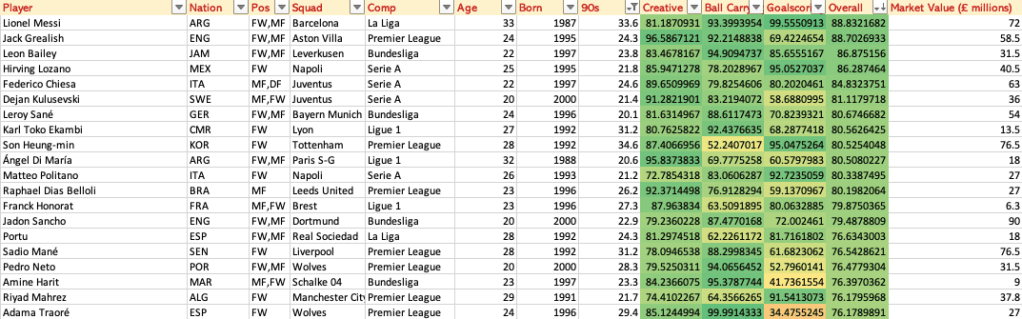
Lionel Messi is rather unsurprisingly at the top of the list, closely followed by £100m man Jack Grealish, showing further indication that Grealish is an elite player and one of the best in his position in Europe. One of Aston Villa’s Grealish replacements, Leon Bailey, sits in third though, so maybe Villa haven’t done too badly in filling the void that Grealish has left behind.
The real focus here isn’t on the superstars though, it’s supposed to be on the players who aren’t getting enough recognition given their performances this season. The only real recognition that matters is that of other football clubs, and I guess one of the only ways to quantify this is by using their market value (from TransferMarkt). I decided to look at wingers with market values less than £15 million that are under the age of 27. In addition, we’re only including players who played at least 1800 minutes last season, mainly to reduce the impact of bit-part players with inflated scores due to the per-ninety adjustment.

Our top 10 looks a bit like this, and all in all it’s a fairly satisfying list given that most of the players here are indeed very underrated from what I’ve seen of all of them. I’d say all ten of them were impressive for different reasons last season, and are all players who I think could kick on in the coming 2021/22 season.
I’ve picked out and written a brief summary on the five who I think are most worth looking out for, mainly on the grounds that they’re players that I’ve seen plenty of as well as players who I’ve been really impressed by.
AMINE HARIT
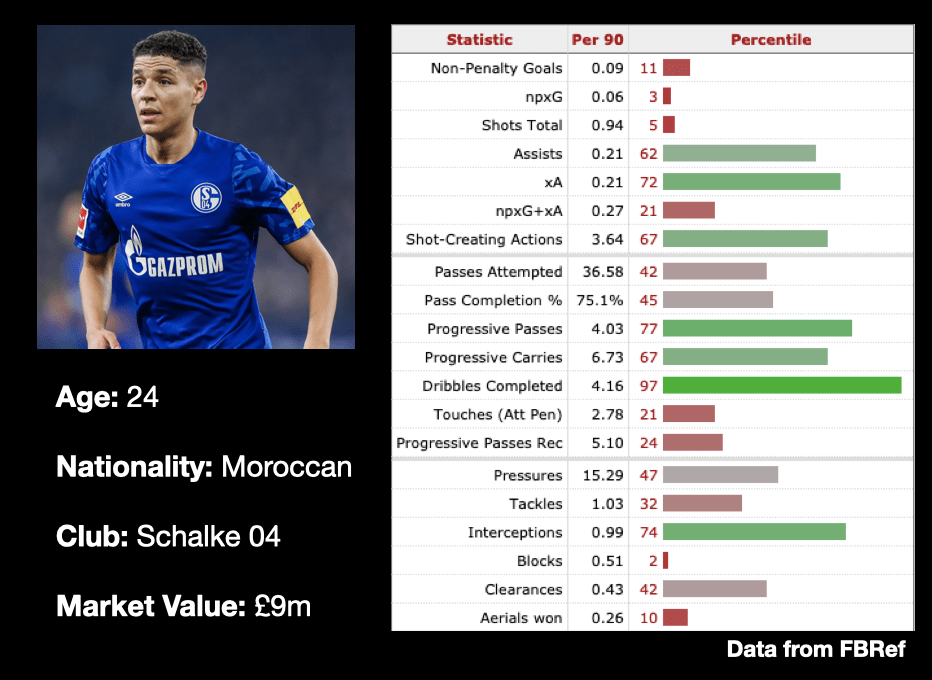
Amine Harit was one of the most highly rated young players in Europe after his first season at Schalke 04 in 2017/18, and although he’s yet to explode, he had a fairly impressive 2020/21 season. Despite Schalke’s torrid season which saw them finish dead last in the Bundesliga, Harit was one of the rare beams of positivity for The Royal Blues. The Moroccan chipped in with 2 goals and 5 assists, as well as regularly being one of the standouts performers for his side including completing the most dribbles in the Bundesliga last season (97).
When Harit first broke out at Nantes, his reputation was very much a ‘skiller’ who had every trick in book, which wasn’t far from the truth. Although his dribbling is still very much his greatest attribute, Harit has adapted and matured a lot from that 19-year old who broke onto the scene in France. He still glides past players for fun, but such is the talent of Harit that he now does so with clever shifts of the ball and changes of pace rather than anything extravagant.
One of the most noticeable things with Harit is how fearless he is; he’s willing to take his man on no matter where he is on the pitch. He regularly drops deep to collect the ball before looking to drive Schalke forward and quicken the tempo.
Schalke’s disjointed season saw them switch between playing 4-2-3-1 and 3-4-1-2, with Harit either playing as an inverted left winger in the first scenario, or as a number 10 when they played three at the back. Schalke’s inability to consistently progress the ball from back to front meant that Harit had to often bear that responsibility, and his stats would suggest he did this very effectively throughout the season.
Despite David Wagner’s fairly unsuccessful time at Veltins Arena, high intensity pressing off-the-ball was one of the key features of his Schalke 04 side, and this was drilled into Harit as well. Wagner’s focus on counterpressing meant that Harit’s discipline and work-rate out of possession was important for Schalke in transition, and so this part of Harit’s game has been fine-tuned over the last two years.
There’s no doubt that Amine Harit’s end product still needs improvement, but there aren’t many others in European football who can carry the ball from the midfield third to the attacking third as consistently as Harit does. In addition, there have been clear signs that he’s starting to sharpen up in the final third, with Harit’s passing and decision making seeming to improve every season. His metrics back this up, especially with the volume of Shot Creating Actions he amassed last season.
Schalke are strapped for cash and are mid-way through performing a full squad overhaul, with Harit expected to move on this summer. Napoli and Atalanta are reported to have submitted bids, but nothing has fully materialised yet. He’s still only 24, so in the right environment and with the correct coaching, Amine Harit can still fulfil that potential that we once expected of him.
JORGE DE FRUTOS
Jorge de Frutos’ emergence onto the La Liga scene arguably made him the biggest surprise package in Spanish football last season. After impressing in Real Madrid’s B team in the third division, he was sent out on loan to Real Valladolid last season where he hardly featured in the top flight. Midway through the season, he then dropped down to La Liga 2 when he was loaned to Rayo Vallecano, where he endured a fairly underwhelming spell, only picking up 2 goals and a single assist.
Despite being very highly rated in Real Madrid’s academy, it seemed like the 24 year old wasn’t ready to make the step up into first-team senior football, until Levante took a gamble and bought de Frutos for less than £2 million at the start of this season. That decision is now looking like a remarkably shrewd bit of business by Levante.
De Frutos began last season as an impact sub, before a man-of-the-match performance against Getafe in December made him a first team regular. From that game onwards, he amassed an impressive 4 goals and 9 assists, making him one of the top creators in La Liga last season, despite his lack of minutes at the start of the season.
Playing on the right of midfield in a 4-4-2 this season, de Frutos’ role at Levante is to be their creative outlet in the final third. Playing in a 4-4-2 requires Levante to have a real creative force in wide areas on the counter, and de Frutos has played that role perfectly this season.
As with many wingers in the modern era, he has pace and trickery, but what makes de Frutos stand out is his ability to consistently create big opportunities for his team.
His link up play and movement in tight situations is excellent, meaning he is frequently able to work crossing opportunities for himself, where De Frutos regularly looks to deliver low crosses into the near post, or lay cutbacks to the edge of the area. Many of his assists and chances created this season have been from these scenarios, where his decision making and execution have been top-notch this season.
His ability to pick out these difficult drilled crosses into the area make him even more perfect for some of the high possession based sides in Europe, whose creativity in wide areas rely on accurate low crosses and cutbacks.
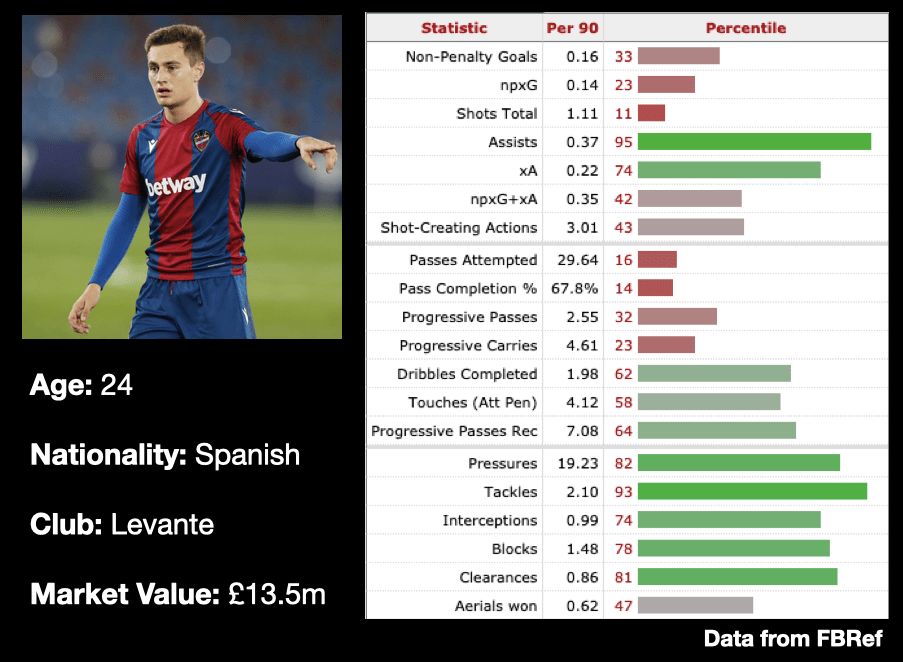
Due to the system that Levante play, de Frutos has a big responsibility defensively too, and he’s carried that out equally as well as his work in attack. Levante completed the 5th most pressures in their attacking third in La Liga last season, and de Frutos was very much a part of this. He weighed in with 19.23 pressures per game, and an impressive 2.13 tackles per game, indicating the willingness and effectiveness of the Spaniard to work for his team even when his team is out of possession. Such was his impact defensively, that his former side Real Madrid have even considered bringing him back with the aim of using him as a right wingback.
Jorge de Frutos had an exceptional breakout season at Levante, but the real test will be whether he can sustain these levels of performance. There’ll definitely be teams around Europe who’ll have their eyes on him, and I don’t expect him to be at Levante for a lot longer. It’ll be very interesting to see if he can continue to impress in a below-average Levante side, so Jorge de Frutos is undoubtedly one to watch in the 2021/22 season.
JACK HARRISON
Marcelo Bielsa’s Leeds United were a breath of fresh air in the Premier League last season with their relentless pressing and high intensity football, which has seen them become one of the most entertaining sides in the league. While the likes of Patrick Bamford, Kalvin Phillips and Raphinha have received immense plaudits for their performances last season, perhaps the real under appreciated gem of the Whites is left-winger Jack Harrison.
Jack Harrison was a machine on the left flank for Leeds, weighing in with an impressive 8 goals and 8 assists in 2020/21, the vast majority being from open play. He was a crucial part of Leeds’ promotion side, before Bielsa brought him back for a second loan spell in which he seamlessly stepped up to Premier League football.
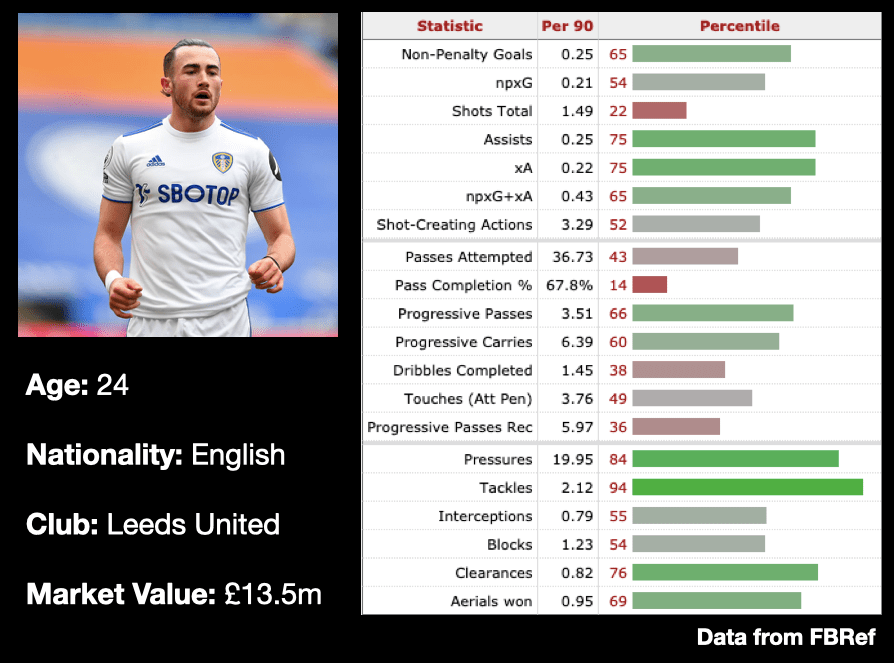
Bielsa’s Leeds play an unfamiliar 3-3-1-3 in possession, and 4-1-4-1 out of possesion, with Harrison playing on the left wing. Harrison is a vintage touchline-hugging winger, playing on his favoured left side while possessing the ability to cross and shoot effectively on his weaker right foot. As with any player in Bielsa’s sides, he covers a ridiculous amount of ground over 90 minutes too, with his engine and ability to work nonstop being a big reason as to why he’s one of Bielsa’s favourites in this Leeds side. Harrison unsurprisingly completed more pressures in all three thirds of the pitch than more than 90% of other wingers in Europe.
To put it simply, Harrison possesses everything a winger needs to have to be successful in the modern era. He’s more than competent as a ball carrier, with a good turn of pace, and his two-footedness and quick feet aiding Harrison to regularly beat his man on the left and whip a cross in. He’s also fairly strong for a winger, meaning he’s not the easiest to knock off the ball either.
The standout attribute that Harrison possesses however, is his raw technical ability. I’d go as far as to say that there aren’t many wingers in the Premier League who can cross a ball as consistently, and strike a ball as cleanly, as Jack Harrison can.
As mentioned earlier, Harrison can consistently create a yard a space for him to deliver, but the quality of deliveries into the area is what makes him so special. Whether it be low drilled crosses, flat crosses whipped into the front post, or floated to the back post, Harrison’s ability to accurately deliver crosses is second to none. It’s one of the main reasons Bielsa is so keen on ensuring his midfield and attack overload the area when the ball moves wide; he knows that the service from Harrison (or Raphinha on the right) will be of a high quality more often than not. His willingness and effectiveness at crossing is reflected by the fact that he completed the 5th highest amount of crosses in the Premier League last season.
As his 8 goals would suggest, he has an eye for a goal too. Harrison’s goal threat is amplified by the fact that he’s tasked with drifting centrally when the ball moves to the right, meaning he regularly receives chances at the back post.
Jack Harrison’s reputation has shot through the roof since Leeds’ first season back in the Premier League, having been one of the key cogs of Marcelo Bielsa’s well-oiled system. Given how he played last season, there’s absolutely nothing to suggest that Jack Harrison won’t continue performing at a really high level.
ROMAIN FAIVRE
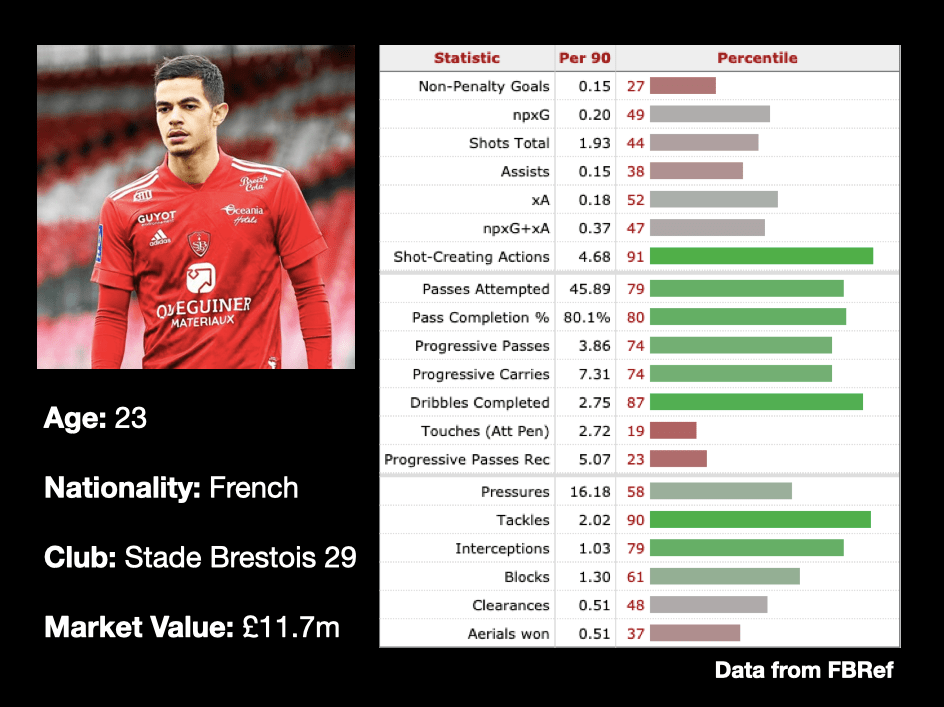
After failing to make an impression at Monaco, Romain Faivre has burst onto the French footballing scene after a £360,000 move to fellow Ligue 1 side Stade Brestois. The lively winger caught the eye after racking up 6 goals and 5 assists last season, with a particular taste for scoring goals against the big sides, having contributed to goals against the likes of Marseille, Monaco and Lyon.
Faivre’s wonderful dribbling and close control, coupled with an electric turn of pace, made him one of the most exciting young talents to watch in Ligue 1 last year. Faivre generally plays on the left of midfield in Brest’s rigid 4-4-2 system, with a clear responsibility of linking the defence to attack and driving Brest forward in transition.
Second to only Kylian Mbappe in dribbles completed in Ligue 1 this season, Faivre is a key part of Brest’s low block-counter attacking system, as he allows them to quickly transition from defence to attack while maintaining a numerical advantage at the top end of the pitch.
An extremely regular feature of Faivre’s play is that he intelligently drifts into the half space to pick up the ball before using his excellent technical ability and close control to resist pressure, and drive into the final third. The winger is a nightmare to defend against in one-on-ones too, with his agility and quick feet helping him to regularly beat fullbacks and deliver into the area.
In addition, Faivre is Brest’s set piece taker, having bagged a couple of assists from corners and indirect free kicks, and having scored a sweetly struck free-kick against Nantes in October. His defensive work rate is another important string in his bow, ranking within the top 20% of wingers in Europe for both tackles and interceptions, showing a good appetite to win back possession for his side.
The only glaring criticism I’d have of Faivre is that he looks noticeably uncomfortable on his right foot, and very much avoids using it, making him a little more predictable to defend against. In addition, he’s not the most clinical in front of goal.
Faivre’s Brest teammate, Franck Honorat also featured near the top in our list, having starred on the opposing flank to Faivre, but out of the two Faivre was overall more impressive to watch and has a higher ceiling than Honorat.
All in all, Faivre has been a shining light in Ligue 1 this season having broken through from relative obscurity. The player he reminds me of most is Raphinha, with a really similar skillset and technique to the ex-Rennes midfielder, so it’ll be interesting to see if he can follow in the Brazilian’s footsteps and make his way to the Premier League. With Manchester United, Leeds United and PSG all interested, it might only be a matter of time before Romain Faivre moves elsewhere.
TINO KADEWERE
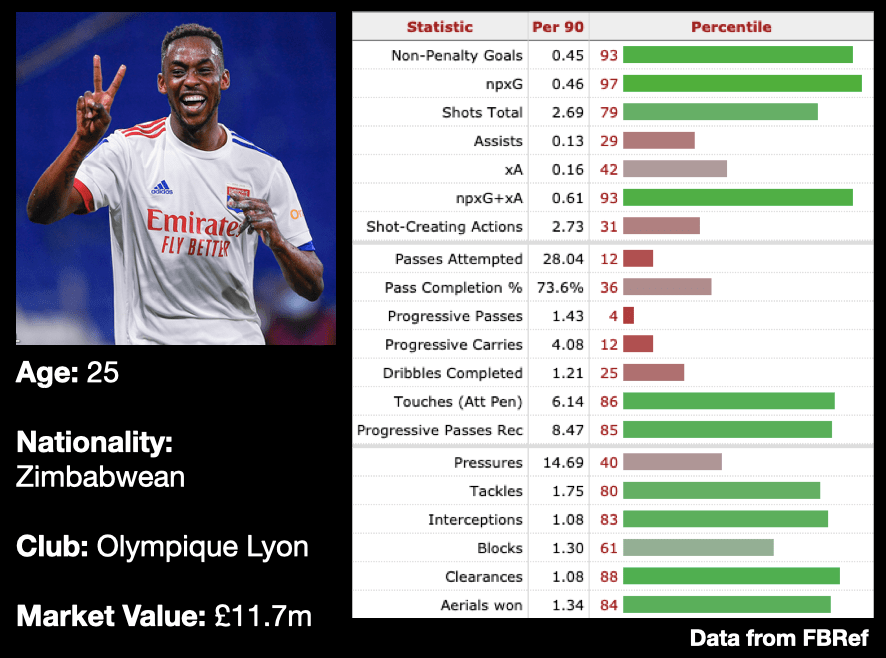
On the back of a decent season at Le Havre in 2018/19, Lyon took a big risk by splashing £11m on a fairly unproven Tino Kadewere. He was subsequently loaned back to Le Havre, where he took Ligue 2 by storm, scoring 20 and assisting 4 in just 24 appearances. Rudi Garcia then integrated the Zimbabwean forward into Lyon’s side, and he’s proved to be a very handy player in Lyon’s front line. Lyon fans weren’t sure what to expect when the 25 year-old arrived, but he’s quickly become a fan favourite having picked up 10 goals and 3 assists last season.
Kadewere is naturally a striker, and played there throughout his time at Le Havre and at Djurgardens in Sweden, but his tendencies to drift wide and be a real threat from the flanks has seen him primarily utilised as a right-winger for Lyon. Rudi Garcia switched to regularly playing 4-3-3 in October, and mainly used a very fluid front three with Memphis Depay playing centrally, with Karl Toko Ekambi and Tino Kadewere either side of him, regularly switching flanks.
Perhaps what’s most different about Kadewere to the four players I’ve talked about already, is the fact that he’s more of an inside forward than a winger. Although he’s a very competent dribbler and can create chances, his real threat lies in his movement and ability to exploit space.
Regardless of which side Kadewere is operating on, he often makes ‘out-to-in’ runs on the blind side of a fullback, which when coupled with his excellent pace – makes Kadewere a massive danger against high defensive lines, and a lot of his chances come from scenarios where he manages to find space in behind.
He’s still very capable technically, with surprisingly good close control despite standing at 6”2. Coupled with the fact that he has an impressive change of pace too, Kadewere became a regular threat with the ball at his feet out wide, consistently beating opponents in 1v1s. His ability to find a yard of space to get a shot away has become a real skill of Kadewere’s too and is one of the main reasons he was able to find the net so regularly last season. With 0.46 non-penalty expected goals per 90 minutes in Ligue 1 last season, this is a clear indication that Kadewere frequently is on the end of chances, due to his movement and ability to carve out opportunities for himself.
Kadewere is a decent finisher too, which is hardly a surprise given his goal tallies throughout the years. He’s capable of scoring on either foot too, with three of his ten goals last season coming from his weaker left boot. His ability to dribble as well as cut in and shoot on both sides has made Kadewere effective regardless of which flank he’s playing on.
In addition, he’s a very intelligent presser and a hard worker off-the-ball too, weighing in with impressive defensive numbers including being in the top 80% of wingers in Europe for tackles and interceptions. It was a requirement in Rudi Garcia’s Lyon side to press extremely high, so all three from that front line had to actively look to win the ball back high up the pitch, but Kadewere was by far the most effective at doing it.
Tino Kadewere was one of the unsung heroes from Rudi Garcia’s entertaining Lyon side in 2020/21, and the fact that he’s proved himself in such a strong Lyon side is a clear indicator of the ability of the Zimbabwean. He’s an extremely complete forward with no noticeable weaknesses, while also possessing the versatility to be effective either out wide or up top.
This season will be a season of change for Kadewere, with Peter Bosz arriving as Lyon’s new manager, and their talisman Memphis Depay leaving the club. 17 year-old winger Rayan Cherki will provide strong competition for Kadewere, but regardless, Kadewere should have a big impact again for Lyon and has the potential to continue to reach even higher levels.


 betweenthelines.sport.blog
Insightful and encyclopedic showing excellent knowledge whilst also illustrating excellent application to the minute details of football across the world. Sky, BBC, BT someone employ this lad.
LikeLike